Simple fire risk assessment · online

Online Fire Risk Assessment 

Complete a self fire risk assessment online for simple, low-risk premises and download a professional PDF report to keep as your fire safety record — built around the Regulatory Reform (Fire Safety) Order 2005. Done in about ten minutes.

  • Professional PDF included
  • No payment until you're ready to download
  • Secure online storage included
Price
From £22.99
Time
~10 minutes
Based on
FSO 2005
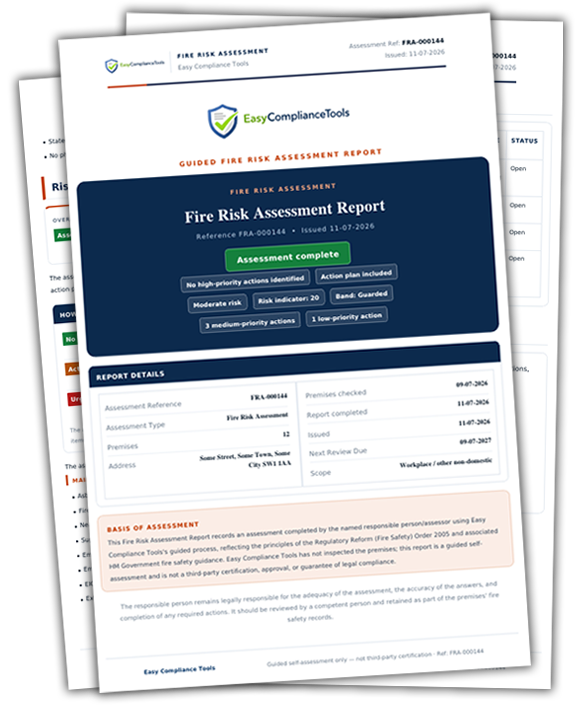
Example fire risk assessment PDF report
  • Professional PDF report
  • Instant download
  • Secure online storage
  • Easy to share
  • Renewal reminders
Built around the Fire Safety Order 2005 Instant PDF download Secure cloud storage Renewal reminders included

Overview

In summary

A fire risk assessment is a structured review of a premises to identify fire hazards, the people who could be at risk, and the measures needed to keep them safe. Easy Compliance Tools lets responsible persons complete a simple, low-risk fire risk assessment online in about ten minutes — from £22.99 — and download a professional PDF report to keep as a fire safety record. The guided workflow is built around the Regulatory Reform (Fire Safety) Order 2005, and is intended for simple, low-risk premises; it recommends a professional fire risk assessor for larger, complex or sleeping-accommodation premises.

Price
From £22.99
Time to complete
~10 minutes
Based on
FSO 2005 & PAS 79
You receive
Professional PDF report
Best for
Simple, low-risk premises
Not for
Complex / sleeping-risk premises

The deliverable

See exactly what you'll receive

You're not buying software — you're buying a finished, professional fire risk assessment report. Here's the exact document that lands in your account the moment you finish.

Example fire risk assessment PDF report
View Sample PDF

Opens a real sample report — no sign-up required

Every assessment includes

  • Professional PDF report

    Branded, structured and ready to present.

  • Instant download

    Available the moment you finish — no waiting.

  • Secure cloud storage

    Your records kept safe and accessible online.

  • Easy sharing

    Email or print for insurers, staff or a fire officer.

  • Free future editing

    Update and re-issue when things change.

  • Renewal reminders

    We'll prompt you when a review is due.

Unlimited downloads. Once you've paid, download your report as many times as you need — there's never a charge to access your own records.

Why it's worth it

The outcomes you get

Real benefits for the responsible person — not a list of software features.

Save money

A fire risk assessor call-out can cost £150–£500+. For simple, low-risk premises you get comparable documentation from £22.99.

Save time

No booking, no waiting for a visit, no chasing paperwork. The guided workflow takes about ten minutes.

Stay organised

Every premises and every assessment lives in one dashboard, so you always know what's due and what's done.

Professional documentation

A clean, branded, dated report you'll be confident sharing with an insurer, employee or fire officer.

Records ready to show

If you're ever asked to show the fire risk was assessed, your evidence is a click away — properly dated and stored.

Secure cloud storage

No lost files or dead USB sticks. Your fire safety history is backed up and available whenever you need it.

How it works

Your report in three simple steps

A guided, jargon-free workflow captures your hazards, escape routes, alarms and management controls — then does the scoring for you.

  1. 1

    Answer guided questions

    Cover building layout, occupants, ignition sources, alarms, fire doors, extinguishers and management controls with plain-English prompts. No technical knowledge needed.

  2. 2
    LOW

    Get instant risk scoring

    Our engine calculates your risk level and highlights urgent actions, medium-priority items and ongoing checks — tailored to your premises.

  3. 3
    ↓ Download PDF

    Download your report

    Instantly receive a branded, dated fire risk assessment PDF — stored securely in your dashboard and ready to share.

Is this for me?

Who this assessment is for

Built for responsible persons of simple, low-risk premises who need to show the fire risk has been assessed and recorded.

Small business owners

Offices, shops and small units with straightforward layouts and no sleeping risk.

Landlords

Common areas of small blocks and shared parts where a fire assessment is expected.

Letting & managing agents

Managing multiple premises and keeping fire safety records tidy for clients.

Employers & managers

The "responsible person" for a workplace who must assess and record fire risk.

Salons, cafés & retail

Small customer-facing premises operating during staffed hours only.

Community & village halls

Single-storey community spaces with simple layouts and clear escape routes.

Honest advice

When this tool is not the right choice

A self-guided assessment suits simple, low-risk premises. If any of the following apply, we recommend a professional fire risk assessor (PAS 79) instead — and the workflow will tell you so.

  • Sleeping accommodation — hotels, B&Bs, care homes, hostels
  • High-rise or multi-storey blocks of flats
  • Large or complex buildings, or industrial processes
  • High numbers of vulnerable people or public assembly
  • Known problems — previous fires, enforcement notices or major concerns
  • You're simply not confident assessing the premises yourself

We'd rather point you to the right help than sell you an unsuitable product. Not sure which side of the line you're on? Read our guide on when a professional is required.

What's in the box

Exactly what's included

No surprises. Here's precisely what you get the moment you complete and pay for your assessment.

Start now — from £22.99
  • Professional PDF report
  • Fire hazard findings
  • Overall risk rating
  • People-at-risk considerations
  • Prioritised action plan
  • Escape route, alarm & extinguisher checks
  • Review / renewal date
  • Secure storage & dashboard access

The difference

Why people choose Easy Compliance Tools

We turn a confusing, time-consuming obligation into something you can finish today — and show tomorrow.

Finished today, not next week

No waiting for a visit or a report. Complete it in minutes and download instantly.

Written around UK fire safety law

Every question maps to the Fire Safety Order and PAS 79, so nothing important gets missed.

Everything in one dashboard

Manage unlimited premises, store every record and never lose a report again.

Honest about limits

We tell you when a professional is the right call — trust matters more than a sale.

Understand the essentials

Fire risk assessments explained

A quick, plain-English grounding in the most important topics before you begin.

What is a fire risk assessment?

A fire risk assessment is a structured look at a premises to work out how a fire could start, who could be harmed, and what needs to be done to reduce the risk. It follows a simple logic: identify the fire hazards (sources of ignition, fuel and oxygen), identify the people at risk, evaluate and reduce the risk, record the significant findings, and set a date to review. In practice that means checking things like electrical safety, heating and cooking, storage of combustibles, escape routes and exits, fire doors, alarms and detection, extinguishers, signage and emergency lighting, plus how the premises is managed day to day. It is an organised inspection-and-recording exercise, not a test or a certificate issued by an authority. For simple, low-risk premises the responsible person can carry it out themselves using a guided workflow, provided they answer honestly and act on the recommendations. The finished record shows the risk was properly considered.

Who is the "responsible person"?

Under the Regulatory Reform (Fire Safety) Order 2005, the duty to manage fire safety sits with the "responsible person". In a workplace that's usually the employer; it can also be the owner, landlord or occupier — anyone who has control of the premises. The responsible person must make sure a fire risk assessment is carried out and kept up to date, and must record the significant findings. There is no requirement to use an external consultant for straightforward, low-risk premises — the law expects the assessment to be done by someone competent, meaning they understand the premises and the fire risks well enough to reach sound conclusions. That is exactly what a guided assessment supports: it walks you through the right questions so a non-specialist can produce a defensible assessment, while flagging the situations where specialist help is genuinely needed. Keeping the finished record on file is how you demonstrate you've met the duty.

How the online assessment works

Rather than starting from a blank template, you answer a sequence of guided questions about your premises: the type and size of building, how it is used, the number and type of occupants, ignition sources and combustible materials, escape routes and exits, fire doors, alarms and detection, firefighting equipment, and how fire safety is managed. Each question is written in plain English with short explanations, so you don't need technical training to answer it. As you go, a scoring engine weighs your answers against recognised guidance and builds an overall risk rating, together with a prioritised list of actions — urgent items first, then medium-priority and routine checks. When you finish, the tool generates a branded, dated PDF that pulls everything together into a professional report. The whole process usually takes about ten minutes for a simple premises. Because everything is saved to your account, you can revisit your answers, update them when something changes, and produce a fresh report without starting over.

When a professional assessment is required

A self-guided assessment is designed for simple, low-risk premises — small offices, shops, units and similar buildings used during staffed hours with ordinary layouts. It is not appropriate where the risk is inherently higher or harder to judge. You should commission a professional fire risk assessor (typically working to PAS 79) if the premises provides sleeping accommodation, such as a hotel, guest house or care home; if it is a high-rise or complex multi-storey building; if large numbers of people or vulnerable people are present; if there are industrial processes or significant fire loads; or if there has been a previous fire, an enforcement notice or other serious concern. You should also seek help if you simply aren't confident assessing the premises yourself. A good rule of thumb: if you can't personally understand and evaluate how people would escape safely, don't guess — get it assessed properly. Our workflow builds this logic in and recommends professional support when your answers point that way.

Common fire safety misconceptions

A frequent misconception is that a fire risk assessment is a one-off "certificate" issued by the fire service. It isn't — it's a record you create and keep, and there is no official certificate. Another myth is that it "lasts" a fixed number of years; in fact there's no legal expiry date, and you review it regularly and whenever something changes, such as a layout alteration, a change of use, new equipment or after any incident. Some small businesses assume they're too small to need one — but the Fire Safety Order applies to virtually all non-domestic premises, and while very small businesses may not need to write down every detail, recording the significant findings is strongly recommended and often expected. Finally, having alarms and extinguishers is not the same as an assessment: those are control measures the assessment checks, not a substitute for it. Clearing up these points helps you focus on what actually keeps people safe and your records defensible.

FAQ

Fire risk assessment questions answered

Clear answers to the most common landlord and small business fire safety queries.

Yes, you can complete an online fire risk assessment yourself if the premises are straightforward, low risk and you are competent to understand the risks. The important test is not whether the document was produced online or by a consultant; it is whether the assessment properly considers the premises, identifies real hazards, records the findings and leads to sensible action. GOV.UK guidance says the responsible person must carry out and regularly review a fire risk assessment, keep a written record, and may do the assessment themselves with the help of standard guidance where appropriate: GOV.UK fire risk assessment guidance.

A self fire risk assessment is usually most realistic where the person completing it knows the building well. Examples might include a small office, shop, salon, studio, unit, community room or simple shared area where the layout is easy to understand and people can leave without unusual difficulty. You still need to inspect the actual premises rather than answer from memory.

Before completing it, walk the escape routes, look at exits, fire doors, alarms, emergency lighting, extinguishers, electrical equipment, heating, cooking, smoking arrangements, waste storage and combustible materials. Think about who may be affected, including staff, visitors, contractors, lone workers and disabled people.

The key is honesty. If something is missing, blocked, untested or uncertain, record it and add an action. An online assessment should help structure your thinking, not replace it. If the building is complex, people sleep there, vulnerable people rely on assistance, or you are unsure whether escape is safe, use a competent fire risk assessor instead.

Get your fire risk assessment in minutes

Join the small businesses and landlords who've swapped paperwork and call-outs for a fast, professional report they can rely on.

  • ~10-minute workflow
  • Instant professional PDF
  • Secure cloud storage
  • Built around the Fire Safety Order