
Thermostatic mixing valves help protect people from scalding, but they also create sections of warm, blended water that need to be considered during a Legionella risk assessment.
This guide explains what a thermostatic mixing valve is, how to recognise one, why its location matters, what maintenance may be required and how temperature checks should be approached.
You can also record whether TMVs are present as part of our guided Legionella risk assessment .
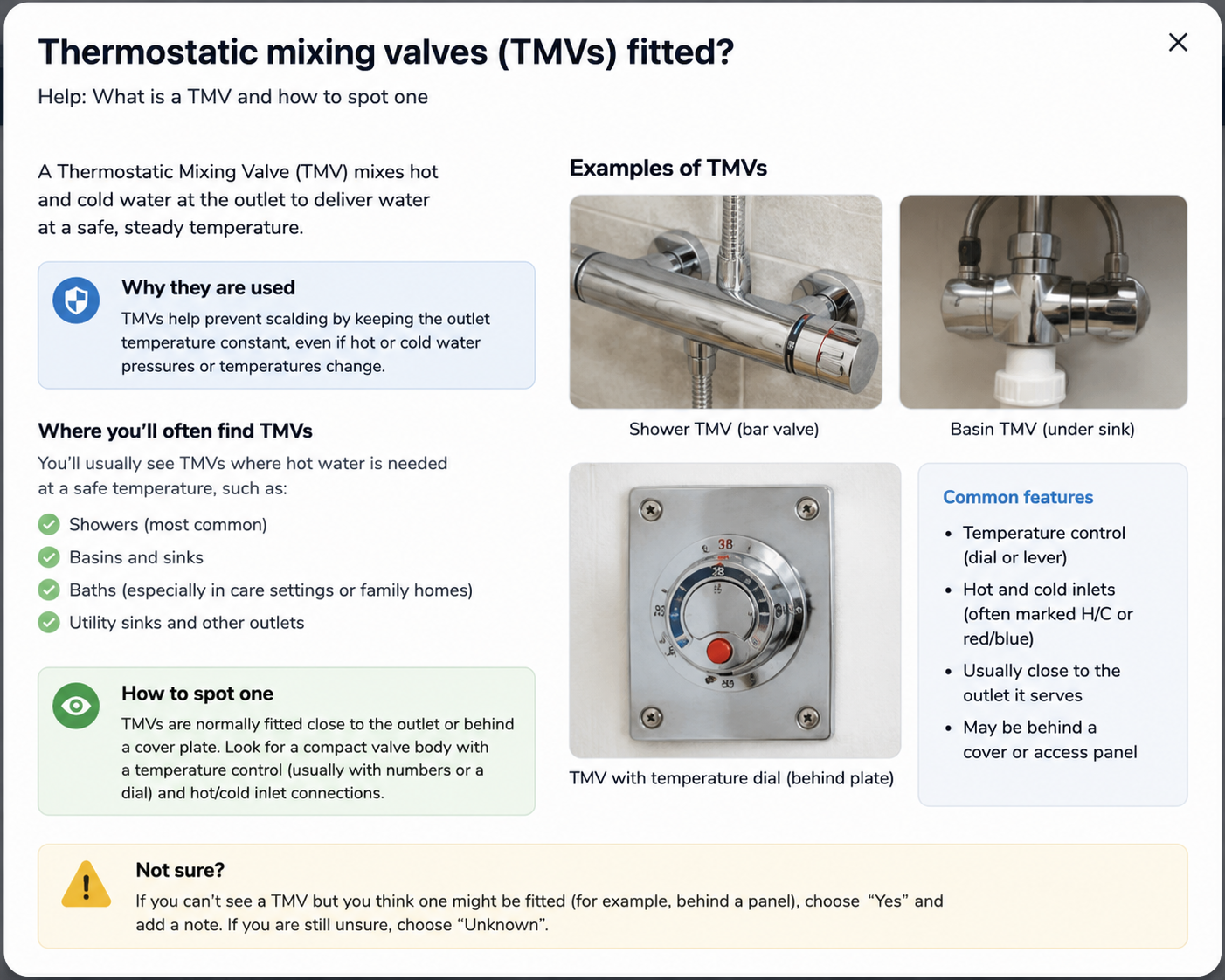
What is a thermostatic mixing valve?
A thermostatic mixing valve, commonly called a TMV, automatically blends hot and cold water before it reaches a tap, bath or shower.
The valve is designed to deliver water at a controlled temperature. If the temperature or pressure of either supply changes, a correctly functioning TMV adjusts the mixture to help keep the outlet temperature stable.
TMVs are primarily used to reduce the risk of scalding. They are especially important where an outlet may be used by:
- young children;
- elderly people;
- people with reduced mobility;
- people with sensory loss;
- people who may not be able to react quickly to hot water.
The blended water delivered by a TMV is commonly cooler than the hot water circulating or stored elsewhere in the system.
Where are TMVs normally found?
A TMV may be:
- built into a thermostatic shower control;
- fitted directly beneath a washbasin;
- installed beneath or beside a bath;
- located behind an access panel;
- installed in nearby pipework serving one or more outlets.
An exposed TMV will often have three pipe connections:
- a hot-water inlet;
- a cold-water inlet;
- a blended-water outlet.
The valve may also be marked with arrows or labels such as H, C, MIX, TMV2 or TMV3.
Is every mixer tap a TMV?
No.
A standard mixer tap allows the user to combine hot and cold water manually. This does not necessarily mean that the tap thermostatically controls the temperature.
A true TMV responds automatically to changes in the hot and cold supplies. For example, it should help prevent a sudden rise in outlet temperature if the cold-water pressure falls.
Similarly, the presence of a single lever or two pipes beneath a tap does not prove that a TMV is fitted.
Thermostatic showers are more likely to contain a thermostatic valve, but the valve may be concealed inside the shower control.
How do TMVs relate to Legionella?
TMVs create a balance between two different safety considerations:
- Scalding prevention: reducing the temperature delivered to the person using the outlet.
- Legionella control: avoiding sections of the water system where warm water can remain and support bacterial growth.
Hot water may be supplied to the TMV at a temperature intended to control Legionella. The valve then mixes it with cold water and produces cooler, blended water.
HSE technical guidance explains that the water downstream of a TMV may provide an environment in which Legionella can multiply. This is because blended water may sit within the temperature range that supports bacterial growth.
This does not mean that TMVs are inherently unsafe or that they should automatically be removed. It means that their need, location, maintenance and pattern of use should be considered as part of the Legionella risk assessment.
Read the official HSE HSG274 Part 2 guidance for hot and cold water systems for the complete technical guidance.
Why should a TMV be close to the outlet?
HSE guidance recommends fitting TMVs as close to the point of use as reasonably practicable.
The point of use is the tap, bath or shower where the water is delivered.
Positioning the valve close to the outlet reduces the length of pipe containing blended water after the valve.
Examples of a close installation include a TMV that is:
- built into the shower control;
- fitted directly beneath the basin it serves;
- located beneath or immediately beside a bath;
- positioned behind a nearby access panel.
If a TMV is installed some distance away, a longer section of pipe may remain full of warm, blended water between uses. The significance of this depends on factors including:
- the length and volume of pipework after the valve;
- how frequently the outlet is used;
- whether one valve supplies several outlets;
- whether water is allowed to stagnate;
- who uses the outlet.
A remote TMV is not automatically proof of an unsafe system. It should, however, be recorded and considered in the context of the whole water system.
Can one TMV supply several outlets?
Some installations use one TMV to supply more than one tap or outlet.
HSE guidance notes that the Legionella risk may be increased where one valve serves multiple outlets. This arrangement can create a larger volume of blended-water pipework and may include branches that receive little use.
Relevant questions include:
- How many outlets does the valve serve?
- Are all those outlets used regularly?
- Is the TMV located close to the outlets?
- Are there long or redundant branches after the valve?
- Can the pipe layout be clearly understood?
If one concealed valve appears to supply several rooms or outlets, it may be sensible to ask a competent plumber to confirm the arrangement.
Do TMVs need to be maintained?
Yes, where a TMV is required, it needs appropriate maintenance.
Scale, debris and wear can affect the internal parts of the valve. Associated strainers or filters may also become restricted or contaminated.
HSE guidance recommends that, where needed, strainers or filters associated with TMVs are inspected, cleaned, descaled and disinfected:
- annually; or
- at another frequency determined by the risk assessment and the manufacturer’s recommendations.
Routine TMV maintenance should be carried out by a competent person in accordance with the manufacturer’s instructions.
What might a TMV maintenance check include?
The exact work depends on the valve model and the manufacturer’s instructions. A competent maintenance check may include:
- checking that the delivered temperature remains stable;
- checking whether the valve responds safely to supply changes;
- checking the fail-safe operation where applicable;
- inspecting and cleaning strainers or filters;
- removing scale or debris;
- checking for leaks or restricted flow;
- checking for sticking or damaged controls;
- confirming that the valve remains suitable for its users;
- adjusting, repairing or replacing the valve where necessary.
Maintenance requirements can vary considerably between products. The valve manufacturer’s instructions should therefore be retained where available.
How often should a TMV be serviced?
There is no single service interval that can be applied blindly to every property and every valve.
HSE’s hot and cold water guidance gives an annual frequency for relevant inspection, cleaning, descaling and disinfection, or another frequency defined by:
- the Legionella risk assessment;
- the condition of the valve;
- the manufacturer’s recommendations;
- the type of premises;
- the vulnerability of the people using the outlet.
Annual maintenance should not automatically be treated as inadequate merely because a more frequent option exists. The correct frequency should be appropriate to the valve and the risks identified.
In higher-risk environments, such as healthcare or care settings, more detailed requirements and monitoring arrangements may apply.
What if there is no TMV service record?
A missing service record does not by itself prove that a TMV is defective. However, it does mean that its maintenance status cannot be confirmed.
A practical response is to:
- check property and plumbing records;
- look for manufacturer or installation information;
- ask the current maintenance contractor;
- include the valve in the next appropriate plumbing or maintenance visit;
- retain a record of the inspection and any work completed.
During a risk assessment, the most accurate answer may therefore be:
TMV maintenance not confirmed. Check available records and include the valve in the next appropriate plumbing inspection.
It is better to record an honest uncertainty and create an action than to state that maintenance has taken place without evidence.
How should water temperatures be checked where a TMV is fitted?
A common source of confusion is that the water leaving a TMV is intentionally cooler than the hot water supplying it.
Measuring only the blended temperature from the tap or shower does not necessarily confirm that the upstream hot-water system is achieving an appropriate temperature for Legionella control.
HSE’s TMV demonstration refers to checking that the hot-water supply to the TMV reaches at least 50°C within one minute of running the water.
This is different from checking the mixed temperature delivered to the user. The blended outlet may be deliberately set considerably lower to reduce the risk of scalding.
Where the hot-water inlet cannot be accessed safely, a landlord should not dismantle the valve or pipework. The check may need to be completed by a competent plumber or assessor.
HSE provides a demonstration of checking the hot-water supply temperature at a TMV .
Does having a TMV mean a property is high risk?
No.
A TMV is a normal safety component in many homes and buildings. Its presence alone does not make a property high risk and should not automatically cause a Legionella assessment to fail.
The assessment should consider:
- why the valve is needed;
- where it is located;
- how much blended pipework it serves;
- whether the outlet is used regularly;
- whether maintenance is confirmed;
- whether temperatures are stable;
- whether the users are particularly vulnerable.
A valve installed close to a regularly used shower, with appropriate maintenance and satisfactory supply temperatures, may present little cause for concern.
More attention may be required where the valve serves several little-used outlets, is remotely located, has no known maintenance history or is associated with unstable water temperatures.
When should a plumber or competent professional be contacted?
Professional assistance should be considered where:
- the location of the TMV or pipework cannot be understood;
- one valve appears to serve several outlets;
- the valve is leaking or damaged;
- water temperatures fluctuate unexpectedly;
- the outlet becomes excessively hot;
- the water flow has reduced significantly;
- controls are stiff, sticking or difficult to adjust;
- the valve has no known maintenance history;
- there is significant scale or debris;
- the outlet is used by particularly vulnerable people;
- the hot-water supply temperature cannot be checked safely.
A competent plumber should use the valve manufacturer’s instructions and consider both scalding protection and water-hygiene risk.
What should a landlord record about a TMV?
A simple record may include:
- which tap, bath or shower the TMV serves;
- whether the valve is visible or concealed;
- whether it is close to the outlet;
- whether it serves one or several outlets;
- the valve make or model, where known;
- the date it was last checked or maintained;
- who completed the work;
- the temperatures recorded;
- any faults or remedial work identified;
- the planned date or trigger for the next check.
This does not need to be a complicated commercial logbook for a simple domestic property. A maintenance invoice, inspection note, spreadsheet entry or property-management record may be sufficient.
How should TMVs be answered in a Legionella risk assessment?
A clear assessment should allow honest, non-technical answers.
Are TMVs fitted?
- Yes: one or more TMVs can be identified.
- No: no TMVs are known to be fitted.
- Not sure: the valve or pipework is concealed or cannot be confirmed.
Are the TMVs maintained?
- Confirmed: checks or maintenance are carried out in accordance with suitable instructions.
- Not in place: there is no known maintenance arrangement.
- Not confirmed: no record or reliable information is currently available.
Are the TMVs close to the outlets?
- Yes: the valve is built into or located immediately beside the outlet.
- No: there appears to be a substantial length of pipe between the valve and outlet.
- Not sure: the valve or downstream pipework is concealed.
An unknown answer should generally be recorded as a limitation or action to confirm the arrangement. It should not be presented as proof that the system is defective.
Frequently asked questions about TMVs and Legionella
Is a thermostatic shower the same as a TMV?
A thermostatic shower normally contains a thermostatic mixing mechanism, but it may be built into the shower control and not visible as a separate valve.
Can I identify a TMV from the tap alone?
Not always. An ordinary mixer tap is not necessarily thermostatic, and a separate TMV may be concealed beneath the basin or behind a panel.
Should I dismantle a TMV during an assessment?
No. Do not remove fittings or dismantle the valve unless you are competent and authorised to perform the work. Record it as not confirmed or ask a competent plumber.
Does a TMV need an annual service certificate?
HSE guidance recommends relevant inspection and maintenance annually or at another frequency determined by the risk assessment and manufacturer. The important issue is that suitable maintenance is completed and recorded; there is no single universal certificate format.
Does a TMV automatically increase the risk score?
Its presence alone should not normally be treated as a defect. The assessment should consider its location, maintenance, downstream pipework, use and the people exposed.
Why is the water from a TMV below 50°C?
The valve deliberately mixes hot and cold water to reduce scalding risk. The relevant Legionella temperature check may need to be taken from the hot-water supply entering the valve rather than from the blended outlet.
Record TMVs in your Legionella risk assessment
Our guided assessment helps landlords and property managers record whether TMVs are fitted, whether their maintenance can be confirmed and whether they appear to be located close to the outlets they serve.
Where something cannot be confirmed, the assessment records the limitation and provides an appropriate action rather than expecting you to dismantle plumbing or guess.