
How Many Gallons of Water Is Normal Per Month?
An unexpectedly high water bill often raises a simple question: how much water should a household normally use in a month? There is no single figure that suits every home. Household size, showers, toilets, appliances, garden use and leaks can all make a noticeable difference.
In the UK, household water use is normally measured in litres or cubic metres. American figures are usually quoted in US gallons, while older UK references may use Imperial gallons. These are different units, so it is important to check which type of gallon is being used before comparing figures.
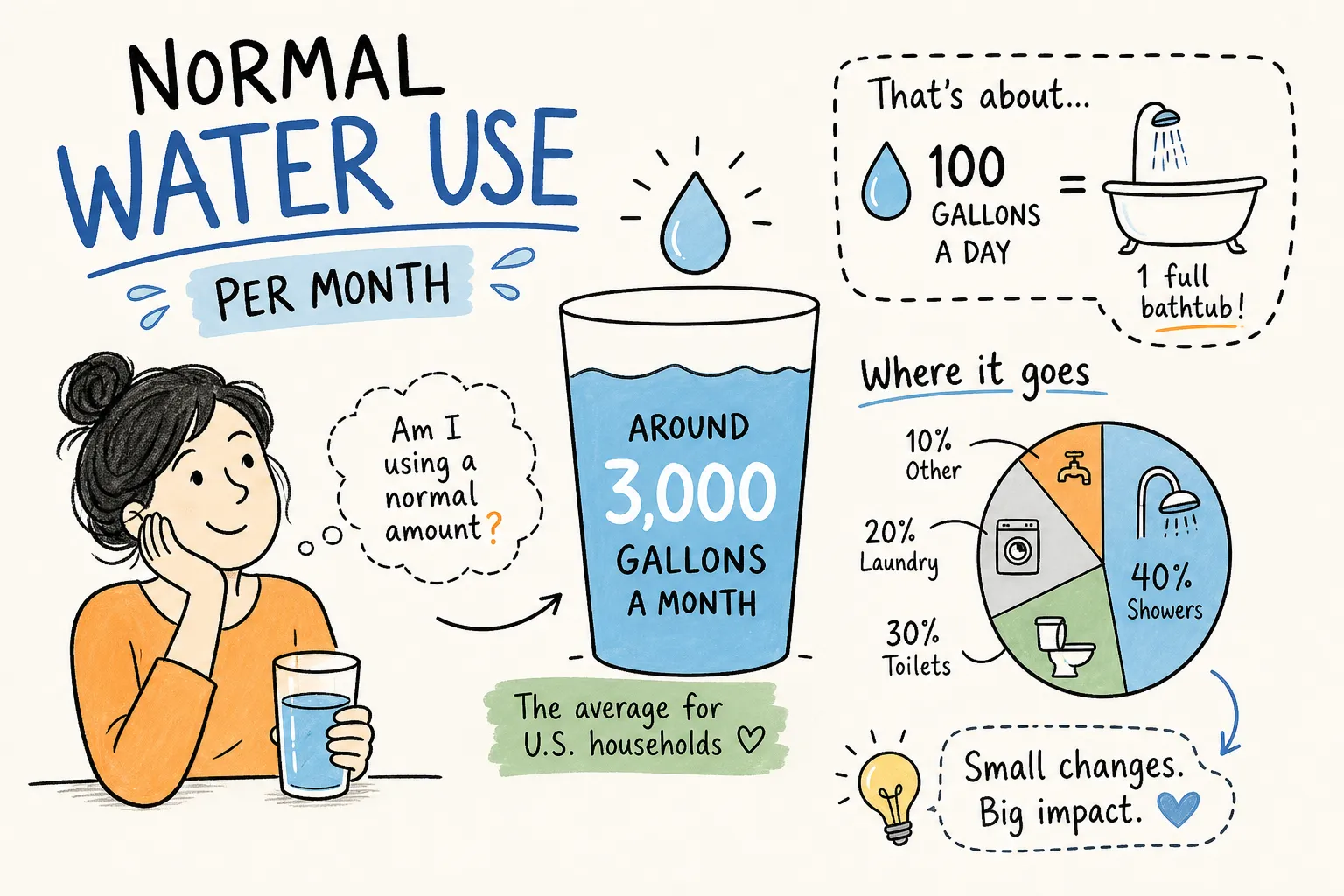
As a broad benchmark, a person in the UK uses around 140 litres of water a day at home. Over a 30-day month, that is approximately 4,200 litres, 4.2 cubic metres or 1,110 US gallons. The US Environmental Protection Agency gives an average of about 82 US gallons per person per day, or roughly 2,460 US gallons per month.
Average monthly water use by household size
The table below uses a rounded UK benchmark of 140 litres per person per day and assumes a 30-day month.
| People in the household | Litres per month | Cubic metres | US gallons | Imperial gallons |
|---|---|---|---|---|
| 1 | 4,200 | 4.2 m³ | About 1,110 | About 924 |
| 2 | 8,400 | 8.4 m³ | About 2,220 | About 1,848 |
| 3 | 12,600 | 12.6 m³ | About 3,330 | About 2,772 |
| 4 | 16,800 | 16.8 m³ | About 4,440 | About 3,696 |
| 5 | 21,000 | 21.0 m³ | About 5,550 | About 4,620 |
A household can sit above or below these figures without there necessarily being a problem. Longer showers, older toilets, frequent laundry, garden watering and visitors can all increase consumption. A sudden or unexplained change is usually more useful than a single isolated reading.
How UK water bills show consumption
Metered UK water bills normally show use in cubic metres. One cubic metre is exactly 1,000 litres.
Example: a bill showing 10 cubic metres means the household used 10,000 litres. That is approximately 2,642 US gallons or 2,200 Imperial gallons.
When comparing bills, make sure the billing periods cover a similar number of days. A quarterly statement cannot be compared directly with a monthly figure without allowing for the different period.
Where household water use normally goes
Bathrooms account for a large share of indoor household water use. Toilets, showers and taps are therefore sensible places to start when trying to understand a high reading. Washing machines and dishwashers can also make a noticeable difference, especially in larger households.
Toilets
A modern dual-flush toilet may use around 4 to 6 litres per flush, while some older cisterns use considerably more. A leaking toilet can also waste water continuously without making much noise, so it is worth checking whether water is running into the pan between flushes.
Showers and baths
Shower consumption depends on both flow rate and duration. A shower running at 12 litres per minute uses 96 litres in eight minutes. Reducing the flow to 6 litres per minute would halve that amount if the shower duration stayed the same.
A full bath commonly uses around 80 litres, although the actual amount depends on the size of the bath and how deeply it is filled.
Taps
Running taps add up quickly during handwashing, food preparation, cleaning and washing up. Aerators and sensible flow rates can reduce use without making a tap impractical.
Washing machines and dishwashers
The most useful figure to check is the manufacturer’s water consumption per cycle. Do not assume that an appliance uses less water simply because it has a good energy rating. Run full loads where possible and compare the litres-per-cycle figure when replacing an appliance.
US gallons and Imperial gallons are different
This is one of the main reasons online comparisons become confusing:
- 1 US gallon equals approximately 3.785 litres.
- 1 Imperial gallon equals approximately 4.546 litres.
An Imperial gallon is about 20% larger than a US gallon. American household-use figures almost always use US gallons, while UK water companies use litres and cubic metres.
Quick conversion examples
- 1,000 litres is about 264 US gallons or 220 Imperial gallons.
- 5,000 litres is about 1,321 US gallons or 1,100 Imperial gallons.
- 10,000 litres is about 2,642 US gallons or 2,200 Imperial gallons.
To convert litres to US gallons, divide by 3.785. To convert litres to Imperial gallons, divide by 4.546.
How to check whether you may have a leak
A sudden rise in consumption with no obvious change in household behaviour is worth investigating. Your water supplier may have its own recommended procedure, but a basic meter test usually follows these steps:
- Turn off all taps and make sure no toilets, appliances or outside outlets are using water.
- Take a clear meter reading or photograph the display.
- Wait for the period recommended by your supplier without using any water.
- Check the meter again.
If the reading has moved, water may still be flowing somewhere on the property. Common causes include a leaking toilet cistern, dripping outside tap, faulty appliance connection or an underground supply-pipe leak.
To help narrow it down, turn off the internal stop tap and check the meter again. If the meter continues to move, the leak may be on the external supply pipe between the meter or boundary and the property. That pipe is usually the property owner’s responsibility, although some water companies offer leak detection, repairs or allowances. Contact your supplier before arranging excavation or repair work.
The Consumer Council for Water provides further guidance on checking a suspected private supply-pipe leak .
When higher water use may be genuine
Not every increase points to a leak. Before assuming something is wrong, consider whether the billing period included:
- more people staying at the property;
- more frequent washing-machine or dishwasher use;
- garden watering or pressure washing;
- filling a pool, hot tub or large paddling pool;
- building, decorating or plumbing work;
- a longer billing period than the previous statement.
Compare the meter readings rather than only the amount charged. Tariff changes can increase the bill even where actual consumption has stayed similar.
Water efficiency requirements for new homes
Household averages are useful for understanding a bill, but new homes are assessed differently. Building Regulations use a calculated design figure based on the specified fittings and appliances rather than the future occupants’ actual behaviour.
England
In England, the standard requirement for a new dwelling is no more than 125 litres of wholesome water per person per day. A planning condition can impose the optional requirement of 110 litres per person per day.
The calculation uses the methodology in Approved Document G and takes account of items such as WC flush volumes, tap and shower flow rates, bath capacity, appliances and qualifying water-reuse systems.
Wales
Wales has separate requirements. A newly erected dwelling is generally assessed against 110 litres per person per day, while the rules provide a 125-litre target for specified material changes of use that create dwellings.
The relevant guidance is available in Welsh Approved Document G .
How the new-dwelling calculation is evidenced
The person carrying out the work must provide the calculated potential consumption to the relevant building control body in accordance with the applicable regulations. The report should show how the result was reached rather than giving only a pass statement.
For developments with repeated house types, identical plots can usually share the same underlying specification and calculation, provided the number of bedrooms, fittings, appliances and water systems are genuinely the same.
Our guide to when a Part G water efficiency calculation is required explains the common project types and submission stages in more detail.
Complete a water efficiency calculation online
The Easy Compliance Tools Water Efficiency Calculator provides a guided route through the new-dwelling calculation. Enter the proposed fittings and appliances, review the full calculation and check the result against the selected target.
The result is shown before payment. A structured PDF calculation report can then be downloaded for the project records and provided to building control where appropriate. The platform also supports house types and plot ranges, which avoids re-entering the same specification for every identical dwelling on a development.
The likely cost depends on whether you prepare the calculation yourself, use an online service or appoint a consultant. Our separate article explains the cost of a Part G water compliance report and includes examples for single homes and multi-plot schemes.
Start the water efficiency calculator
Summary
Using a rounded UK benchmark, one person may use about 4,200 litres of water in a 30-day month. That is roughly 1,110 US gallons or 924 Imperial gallons. A larger household will normally use more, but the most useful warning sign is often a sudden change that cannot be explained by visitors, appliances, garden use or a longer billing period.
When consumption looks unusual, check the meter with every outlet turned off and contact the water supplier if the reading continues to move. For a new dwelling, household averages are not used to prove compliance: the design must be assessed using the applicable Part G methodology and target.