Understand the essentials
Legionella risk assessments explained
A quick, plain-English grounding in the most important topics before you begin.
What is a Legionella risk assessment?
A Legionella risk assessment is a structured check of a property's water system to work out whether Legionella bacteria could grow and put people at risk. It looks at where water is stored and heated, how it moves around the building, and where conditions might let bacteria multiply — for example water sitting between 20°C and 45°C, stagnant pipework, little-used outlets, or scale and sludge in tanks. The assessment records these findings, rates the overall risk, and sets out sensible control measures such as keeping hot water hot, cold water cold, and flushing outlets that aren't used often. It is a paperwork-and-inspection exercise, not a laboratory test. For most simple, lower-risk premises the responsible person can carry it out themselves using a guided workflow, provided they answer honestly and act on the recommendations. The result is a documented record showing the hazard was properly considered.
Who is responsible?
Under UK health and safety law, the "duty holder" is responsible for assessing and controlling Legionella risk. For a rental property that's usually the landlord or managing agent; for a business it's typically the employer or whoever is in control of the premises. The Health and Safety at Work Act and the COSHH Regulations require duty holders to assess the risk of Legionella and take reasonable steps to control it. There is no requirement to use an external consultant for straightforward, low-risk systems — the law expects the assessment to be carried out by someone competent, meaning they understand the system and the risks well enough to reach sound conclusions. That's exactly what a guided assessment supports: it walks you through the right questions so a non-specialist can complete a defensible assessment, while flagging the situations where specialist help is genuinely needed. Keeping the finished record on file is how you show you've met that duty.
How the online assessment works
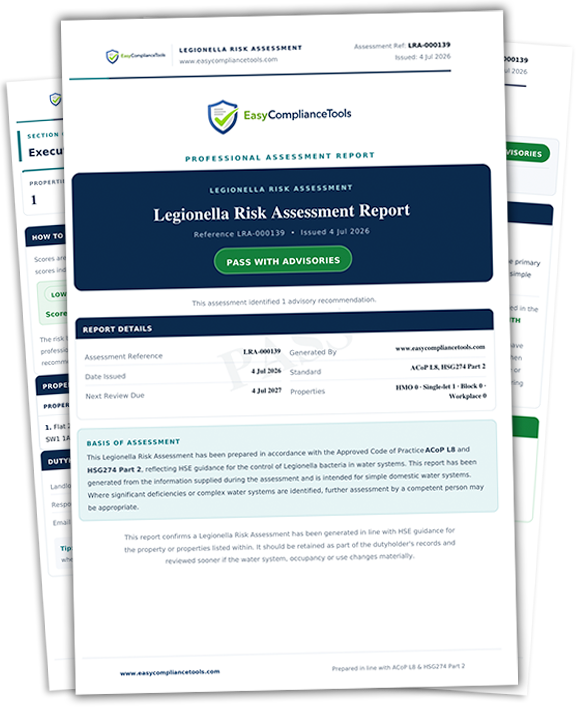
Rather than starting from a blank template, you answer a sequence of guided questions about your building and its water system: the type of property, how water is stored and heated, typical temperatures, which outlets get used, and what monitoring already happens. Each question is written in plain English with short explanations, so you don't need technical training to answer it. As you go, a scoring engine weighs your answers against recognised guidance and builds an overall risk rating, together with a prioritised list of actions — urgent items first, then medium-priority and routine checks. When you finish, the tool generates a branded, dated PDF that pulls all of this together into a professional report. The whole process usually takes about 2 minutes for a simple property. Because everything is saved to your account, you can revisit your answers, update them when something changes, and produce a fresh report without starting over.
When a professional assessment is required
A self-guided assessment is designed for simple, lower-risk premises — most domestic rentals, small offices and similar buildings with ordinary hot and cold water systems. It is not appropriate where the risk is inherently higher or harder to judge. You should bring in a professional Legionella assessor if the site has cooling towers, evaporative condensers, spa pools or hot tubs; if it's a healthcare or care setting, or houses people who are especially vulnerable to infection; if the water system is large or complex; or if there's a history of temperature problems or water quality issues. You should also seek help if you simply aren't confident inspecting the system yourself. A good rule of thumb: if you can't personally confirm how the system is set up and controlled, don't guess — get it assessed properly. Our workflow builds this logic in and will recommend professional support when your answers point that way.
Common misconceptions
The biggest misconception is that a risk assessment and water sampling are the same thing — they aren't. A risk assessment reviews the whole system and its controls; water testing analyses a sample and is only needed in particular, usually higher-risk, situations. Another myth is that a report "lasts" a fixed number of years. In fact there's no legal expiry date; you review the assessment when something changes — a new tank or boiler, renovations, a change of use, or a long void period. Some landlords also assume domestic properties are exempt. They're not: the risk is usually low, but the duty to consider it still applies. Finally, "temperature monitoring" is sometimes confused with a full assessment — monitoring is one control measure that feeds into the assessment, not a replacement for it. Clearing up these points helps you focus on what actually keeps people safe and your records defensible.